Concrete Surface Preparation Methods: Grinding vs Scarifying vs Shot Blasting

Concrete surface preparation is the process of cleaning and roughening a slab so a coating, overlay or repair bonds properly. The three main mechanical methods are grinding, scarifying and shot blasting. Grinding suits sealers and thin coatings, shot blasting gives the textured finish thicker coatings need, and scarifying removes the most concrete.
Choosing the wrong method costs time on site and can lead to a coating that lifts or peels. This guide explains what each method does, compares them side by side and shows which machine suits which job, so you can hire the right gear the first time.
What is concrete surface preparation?
Concrete surface preparation means removing anything that stops a new finish from gripping the slab, then giving the surface the right texture. That can include old coatings, glue, sealers, oil, dirt and laitance, which is the weak, powdery layer of cement and fine particles that bleed water carries to the top of a slab while the concrete is still fresh.
The International Concrete Repair Institute (ICRI) describes the goal as a clean, sound and roughened surface. Its introduction to the surface preparation guideline puts it simply: proper preparation is the key to success, and there are no shortcuts.
What is a concrete surface profile (CSP)?
A concrete surface profile (CSP) is a measure of how rough a prepared slab is. ICRI’s Technical Guideline No. 310.2R sets out ten profiles, from CSP 1 (almost flat) to CSP 10 (very rough, with peaks and valleys more than 6 mm deep). Contractors compare the prepared floor against a set of ICRI reference chips to check it matches the specification.
ICRI’s reference chips show where each method sits on the scale. The higher the number, the rougher the surface and the more grip it gives a coating.
| Concrete Surface Profile | Method it shows |
|---|---|
| CSP 1-2 | Grinding |
| CSP 2-9 | Shotblasting |
| CSP 4-7 | Scarifying |
The coating system decides the profile, not the machine. Always check the concrete surface profile listed on the coating manufacturer’s product data sheet before you choose a method. You can read more in ICRI’s introduction to Guideline 310.2R.
Grinding vs scarifying vs shot blasting: how do they compare?
Each method removes material in a different way and leaves a different finish. The table below sums up the main differences.
| Method | How it works | Surface it leaves | Best for | Concrete Hire range |
|---|---|---|---|---|
| Grinding | Diamond tools on spinning heads wear the surface down | Smooth to lightly textured, at the low end of the CSP scale | Thin coatings, glue, sealers, levelling high spots, polishing | Floor grinders, from handheld to double head and remote control |
| Scarifying | A drum of hardened cutters chips away the top of the slab | Rough and grooved, from the middle to the top of the CSP scale | Thick coatings, screeds, trip hazards, heavy removal, adding grip | Scarifiers and shavers, in 240v, 415v, petrol and diesel |
| Shot blasting | A spinning wheel fires steel shot at the floor, and the shot is collected and reused | Evenly textured and non-slip | Laitance, coatings and contaminants before thicker coatings or overlays | Shot blasters, in 240v and 415v with dust collection |
When should you grind concrete?
Grinding uses diamond tooling fitted to one or more spinning heads to wear down the surface of the slab. It produces the lightest profile of the three methods, which makes it the first choice when you need a flat, clean surface without cutting too deep.
Commercial crews grind concrete to:
- remove thin coatings, paint, sealers, and glue
- take down high spots and small lips between slabs
- open up a slab for sealers and thin coatings
- prepare and polish floors using finer grits
Which type of grinder do you need?
A planetary grinder usually has three smaller grinding heads that spin inside a larger main plate turning the opposite way, which spreads the cut evenly. Match the grinder to the size of the area and the finish you need.
| Grinder type | Best for |
|---|---|
| Planetary grinder | Large slabs that need a smooth, even finish, including polishing. Pair it with a heavy-duty vacuum. |
| Double head grinder, such as the Satellite 760 Dual | Hard-working commercial floor preparation, with a 760 mm cutting width |
| Remote-control grinder | Covering big spaces fast |
| 240v grinder | Smaller areas on standard 240v power |
| Handheld grinder | Edges, corners and tight access a floor machine can’t reach |
The right diamond tooling matters as much as the machine. Tell us about your slab and the coating you’re removing, and we’ll match the tooling to the job.
Featured product: Grinder Planetary 415v Remote Control PG830
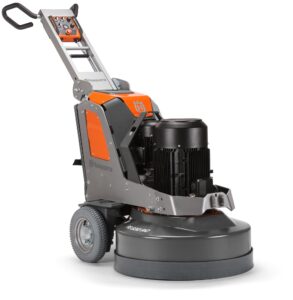
The PG 830 RC is the largest and most powerful remote-controlled floor grinder in the Husqvarna PG-range. The remote control sets the operator free to manage hoses and cables while still grinding, for up to 40% higher productivity. A powerful choice for most grinding jobs, both industrial and commercial.
When should you scarify concrete?
Scarifying uses a rotating drum fitted with rows of hardened cutters. The cutters strike the surface and chip it away. Scarifying is built for heavier removal than grinding.
Our scarifier range covers several machine types:
| Scarifier type | Suited to |
|---|---|
| Handheld and small 240v scarifiers | Tight spaces and detailed work |
| 415v scarifiers | Indoor removal of thick coatings, epoxies, trip hazards and high spots, taking off 4 to 7 mm per pass depending on the model |
| Petrol scarifiers | Coating removal and trip hazards away from mains power |
| Diesel self-propelled scarifier | Mine sites and outdoor use, taking off 5 to 7 mm per pass |
| Concrete shaver | Lowering floors and adding grip to ramps, driveways and footpaths. Its 80 diamond blades are banked together to shave the concrete off in a single pass. |
Scarifying is the right call when you need to:
- remove thick coatings, screeds (thin levelling layers laid over the slab) or built-up material
- take out trip hazards and high spots quickly
- lower a floor level
- add grip to ramps, driveways and footpaths
Because scarifying is aggressive, it can cause fine cracks in the top of the slab. If you’re coating afterwards, plan a follow-up pass with a grinder or shot blaster to refine the surface to the profile the coating needs.
When should you shot blast concrete?
Shot blasting fires small steel pellets, called shot, at the floor from a fast-spinning wheel. The impact breaks away coatings, dirt and weak concrete. A built-in return system collects the shot for reuse while a vacuum or dust collector captures the debris, so the process runs dry with no water or chemicals.
Shot blasting leaves an even, textured, non-slip finish. Use it to:
- remove laitance from new slabs
- strip coatings and contaminants
- prepare floors for thicker coatings and overlays (new topping layers laid over the old slab) that need more grip than a ground surface gives
Operators control the result by adjusting shot size, machine speed and how fast the machine travels across the floor.
Our shot blaster range includes compact 240v machines and a heavy-duty 415v machine, all supplied with dust collection. The 415v machine also prepares steel and asphalt as well as concrete, in smaller, tighter areas.
Which surface preparation method suits your job?
Start with the result the coating or finish needs, then work back to the method. Use the table below as a starting point and confirm against the coating’s product data sheet.
| Job on site | Start with | Why |
|---|---|---|
| Removing a thin sealer or paint before recoating | Grinding | Light removal with a smooth, even finish |
| Preparing a new slab with laitance for a thick coating | Shot blasting | Removes the weak top layer and leaves an even texture |
| Removing a thick coating or old screed | Scarifying, then grinding or shot blasting | Fast bulk removal, then a finer pass to reach the right profile |
| Taking out trip hazards or high spots | Scarifying or grinding | Scarify for deep lips, grind for small ones |
| Polishing a floor | Planetary grinding | Even cut across large areas through each grit |
| Lifting tiles, vinyl or thick adhesive | Floor stripping, then grinding | Strip the covering first, then grind off leftover glue |
Many commercial jobs use more than one method. A common sequence is to scarify or strip first for bulk removal, then grind or shot blast to reach the final profile.
What happens after the slab is prepared?
Once the slab is prepared, repair work often follows. A grout pump places grout, mortar and slurry through a hose, which is faster and easier than placing it by hand. Common uses include; void filling, underpinning, block filling, or repairs. Our grout pump hire range runs from manual units for small fills to powered grout stations for larger jobs that need continuous pumping.
Is acid etching a good alternative to mechanical preparation?
Acid etching uses an acid solution to lightly roughen the top of a slab. It can work for some sealers and light coatings, but it has limits:
- acid is hard to rinse out and neutralise fully
- it needs good ventilation
- it won’t remove oil or grease from the concrete
That’s why mechanical methods such as grinding or shot blasting are generally the safer and more reliable choice.
How do you control silica dust during surface preparation?
Concrete contains crystalline silica. Grinding, cutting and chiselling concrete releases fine respirable dust that can cause permanent lung damage. In Australia, the workplace exposure standard for respirable crystalline silica is 0.05 mg/m³, averaged over an eight-hour day. That limit must not be exceeded, as set out by Safe Work Australia.
WorkSafe WA recommends controls including:
- on-tool dust extraction or local exhaust ventilation
- vacuum clean-up in place of dry sweeping
- never blowing dust off with compressed air
- a suitable respirator, selected to AS/NZS 1715, where other controls aren’t enough
Pair every grinder, scarifier and shot blaster with extraction that suits the machine. Our shot blasters come with dust collection, all our commercial vacuums have HEPA filters, and our large dust collector is equipped with six M-class cartridge filters. Our team can recommend the right extraction for grinders and scarifiers.
As well as controlling dust, wear hearing and eye protection when operating surface preparation machines.
What else should you plan for before hiring?
- Power supply: Many commercial machines run on 415v, which is three-phase power. Check the site has a suitable outlet before hire day. If it doesn’t, talk to us about power options.
- Access and weight: Large floor machines are heavy. Several of our larger machines weigh more than 300 kg, including the Grinder Large Double Head 415v at 340 kg, so check doorways, lifts and floor loading before delivery.
- Tooling: Match diamond segments or cutters to the hardness of the slab and the coating you’re removing.
- A test area: Prepare and coat a small section first, in the same conditions as the main job, to confirm the profile is right.
Engine-driven machines produce exhaust fumes, so choose electric for enclosed indoor areas and save petrol, diesel and LPG machines for outdoor or well-ventilated sites without mains power.
| Power type | Best suited to | Available in our range |
|---|---|---|
| 415v electric (three-phase) | Indoor commercial work where fumes would be a problem | Grinders, scarifiers and shot blasters |
| 240v electric | Smaller areas on standard power | Grinders, scarifiers and shot blasters |
| Petrol | Coating removal and trip hazards away from mains power | Grinders and scarifiers |
| Diesel | Mine sites and outdoor use | Scarifiers |
| LPG | Outdoor and large-scale grinding | Grinders |
What about mining and civil sites?
Remote and outdoor sites often have no mains power. Useful options in our range include:
-
- a diesel self-propelled scarifier, built for mine sites and outdoor use, which removes 5 to 7 mm of concrete per pass
- our heavy-duty 415v shot blaster, which prepares steel and asphalt as well as concrete
For 415v machines on sites without three-phase power, talk to us about power options before hire day. We can arrange delivery to site, extend a hire if the job runs longer and arrange servicing or swap-outs on extended contracts.
Example: preparing a warehouse floor in Perth for a new coating
Here’s how the methods might come together on a typical job. A coatings contractor is recoating a warehouse floor in one of Perth’s industrial areas. The old coating is worn through in the traffic lanes, and a few slab joints have lifted into trip hazards. The new system’s data sheet calls for a textured profile.
A practical plan:
- Step 1: confirm three-phase power on site before the gear is delivered.
- Step 2: scarify the lifted joints to remove the trip hazards.
- Step 3: shot blast the main floor to remove the old coating and reach the specified profile.
- Step 4: finish the edges with handheld grinders.
- Step 5: run dust extraction on every machine throughout.
Talking the plan through with our team before hire day helps keep the job on time and on budget.
Frequently asked questions
What is the best concrete surface preparation for epoxy?
It depends on the epoxy system. Thin-film epoxies and sealers, which go on in thin coats, usually need a lightly textured surface, which grinding provides. Thicker, high-build epoxies usually need a rougher profile, which shot blasting provides. Always follow the concrete surface profile listed on the product data sheet.
Is shot blasting better than grinding?
Neither is better overall. Grinding gives a smoother, lighter profile and suits thin coatings, sealers and polishing. Shot blasting gives an even, textured finish and suits thicker coatings and overlays. Many jobs use both.
How much concrete does a scarifier remove?
It depends on the machine and the slab. Our 415v and diesel scarifiers remove between 4 and 7 mm of concrete per pass, depending on the model.
Do surface preparation machines need three-phase power?
Larger commercial grinders, scarifiers and shot blasters often run on 415v three-phase power. Smaller models run on standard 240v power, and petrol, diesel and LPG options suit sites without mains power. Talk to us about power options if your site has no three-phase supply.
Can I hire surface preparation machines with dust extraction in Perth?
Yes. Our shot blasters come with dust collection, all our commercial vacuums have HEPA filters, and our large dust collector is equipped with six M-class cartridge filters. Our team can recommend the right extraction to pair with our grinders and scarifiers for your site.
How do I know which machine to hire?
Tell us about the slab, what’s on it now and the finish you need. Our quote form asks for your desired result and the power available on site, which helps our team recommend the right machine and tooling. You can also call 1300 048 521 to talk it through.
Hire surface preparation equipment in Perth
Concrete Hire supplies grinders, scarifiers and shot blasters for commercial, civil and trade projects across Perth and WA. Every machine is maintained to professional standards and backed by our Canning Vale service centre. Browse our surface preparation equipment hire range or call 1300 048 521 and we’ll help you choose the right machine for the job.